> For the complete documentation index, see [llms.txt](https://kimberlite-token.gitbook.io/kimbertoken/llms.txt). Markdown versions of documentation pages are available by appending `.md` to page URLs; this page is available as [Markdown](https://kimberlite-token.gitbook.io/kimbertoken/diamond-buyers-guide/essential-diamond-terms-for-beginners.md).
# Essential Diamond Terms for Beginners
This guide explains the most important terms used in the diamond industry in simple, easy-to-understand language. Whether you are completely new to diamonds or just starting to explore rough diamond investing, these foundational concepts will help you make more confident decisions.
### Rough Diamond vs Cut (Polished) Diamond
* **Rough Diamond** — A diamond in its natural, uncut form straight from the mine. It has a rough, uneven surface and looks very different from the sparkling gems seen in jewelry.
* **Cut (Polished) Diamond** — A rough diamond that has been carefully cut and polished by expert craftsmen.
#### Value Increase Through Cutting and Polishing
Cutting and polishing a rough diamond can dramatically increase its value — often by 300% to 400% or more. This process removes the rough outer layer, shapes the stone, and unlocks its natural brilliance, fire, and sparkle.
***
### The 4Cs – The Most Important Factors
Experts use the **4Cs** — Color, Clarity, Carat Weight (size) and, Cut potential (shape), to judge diamond quality. These work slightly differently for rough diamonds compared to polished ones.
#### 1. Color
Color is one of the most important factors in determining a diamond’s value. Most people think of diamonds as colorless (white), but they actually come in a wide range of hues.
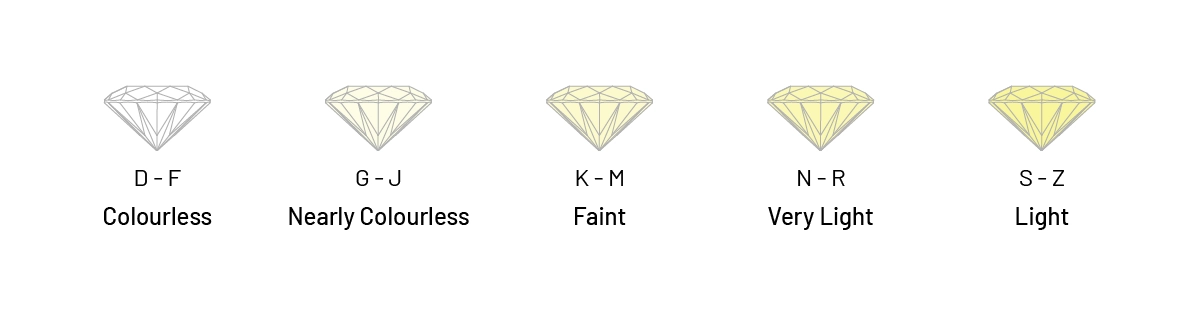
Diamonds are graded on a color scale from **D to Z**:
* **D to F:** Completely colorless — the rarest and most valuable.
* **G to H:** Near colorless — still excellent quality and very popular.
* **I to J:** Slight traces of color, usually only noticeable to experts.
* **K to Z:** Noticeable yellow or brown tint — generally less valuable for standard jewelry but can be desirable in Fancy Colored diamonds.
**KimberLite sources the finest rough diamonds in colors ranging from D to H**, ensuring top quality for every eDiamond.
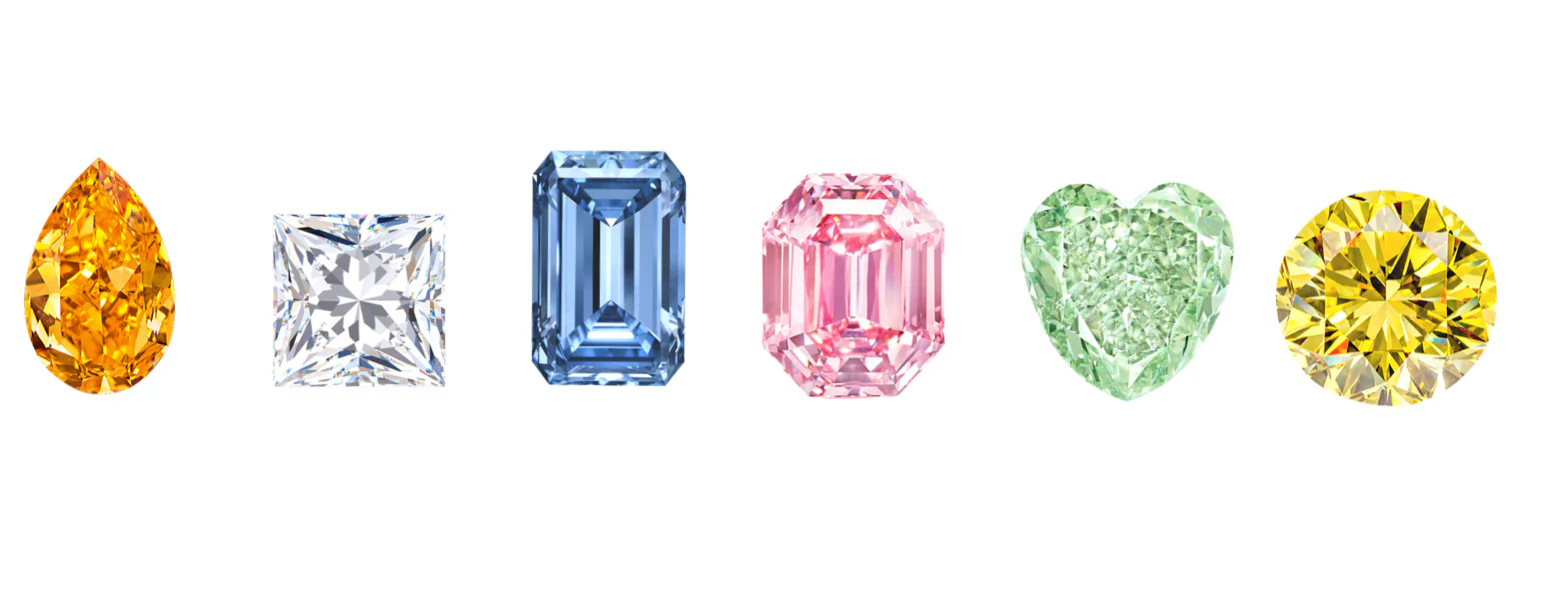
**Fancy Colored Diamonds are an exception.** These rare stones display strong, attractive natural colors such as pink, blue, yellow, green, or red.
These colors are caused by trace elements (like nitrogen or boron) or structural irregularities in the crystal. Fancy Colored Diamonds are graded differently and often sell for premium prices due to their extreme rarity and beauty.
#### 2. Clarity
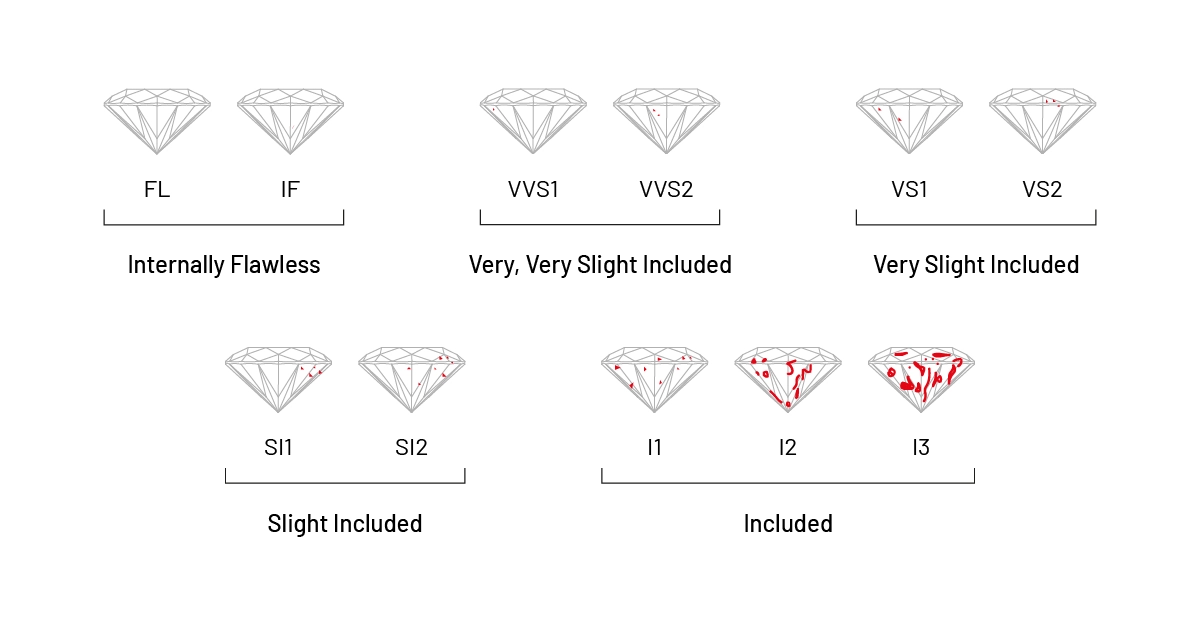
Clarity measures the number of natural flaws — known as inclusions (inside the stone) and blemishes (on the surface) — in a rough diamond.
These tiny marks are usually invisible to the naked eye and only visible under 10x magnification. Diamonds with fewer flaws allow more light to pass through, making them brighter and more valuable.
At KimberLite, we focus on high-quality **Gem-Grade** diamonds with strong clarity:
* **Flawless (FL):** The rarest grade — no inclusions or blemishes visible even under 10x magnification.
* **Internally Flawless (IF):** No internal inclusions under 10x magnification, though minor surface blemishes may exist.
* **Very, Very Slightly Included (VVS1 – VVS2)**: Tiny inclusions that are extremely difficult for even experts to see under 10x magnification.
* **Very Slightly Included (VS1 – VS2):** Small inclusions visible to a skilled eye under 10x magnification, but they do not affect the diamond’s overall beauty.
#### 3. Carat Weight (Size)
Carat measures how much the diamond weighs (1 carat = 0.2 grams). In rough diamonds, **larger stones (especially 5+ carats)** usually offer better profit potential because they can produce bigger polished diamonds. However, a large stone with many flaws may be worth less than a smaller, cleaner one.
#### 4. Cut Potential (Shape)
**Why Shape Matters** — The natural shape of a rough diamond is very important because it determines how much polished diamond can be recovered after cutting. Good shapes waste less material and produce more beautiful and valuable finished gems.
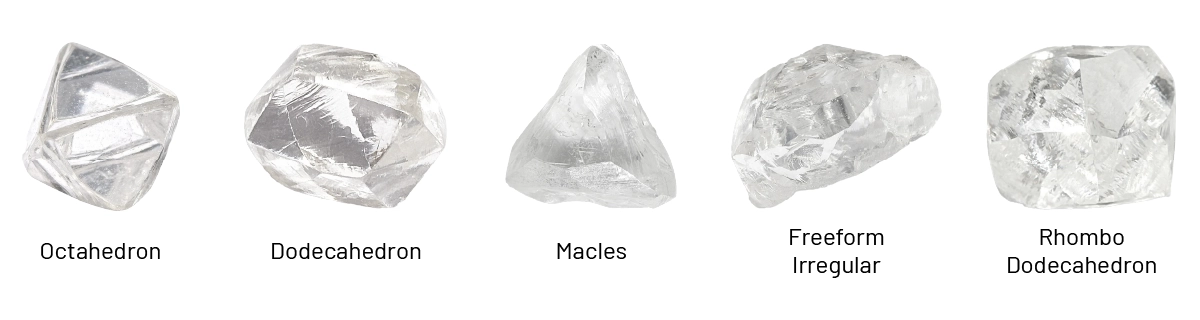
Common rough diamond shapes include:
* **Octahedron:** Two pyramids joined at the base — often yields high-quality round brilliant cuts with minimal waste.
* **Dodecahedron:** A twelve-sided, more blocky shape that is versatile for various cuts.
* **Macles:** Twinned crystals that look like a butterfly — can be more challenging to cut and may result in lower yields.
* **Freeform / Irregular (Cleavages):** Flattened or irregular shapes that are easier to cut into simpler forms but may contain more inclusions.
***
### Transparency
Transparency measures how easily light passes through the stone. Higher transparency usually means fewer internal flaws and better potential sparkle after cutting.
***
### Kimberley Process Certificate (KPC)
The **Kimberley Process Certification Scheme (KPCS)** is an international agreement launched in 2003 to stop the trade of **conflict diamonds** (also known as blood diamonds) that once funded brutal civil wars in parts of Africa.
A valid Kimberley Process Certificate confirms that a rough diamond is conflict-free and has been legally exported. The system was inspired by a 2000 United Nations resolution and remains one of the key tools ensuring ethical sourcing in the global diamond trade.
***
### Gemologist – The Diamond Expert
A **Gemologist** is a trained professional who acts like a “diamond detective.” They carefully examine stones to assess quality, authenticity, and value using specialized tools.
Gemologists evaluate diamonds under loupes and microscopes, check for inclusions and treatments using UV light, and grade the 4Cs (Color, Clarity, Carat weight, and Cut potential). Their expert analysis provides buyers with a clear, reliable understanding of each diamond’s true characteristics and potential value.